

Ingredient facts · UK shelf language · No sales here
Joint capsules and cartilage support, explained plainly
Most people arrive here with the same question in a different shape. Maybe your knees feel stiff on the stairs, or you want to know what glucosamine actually is before you buy a bottle. This is a reading resource for UK shoppers who want the ingredient facts without the hard sell.
A reading room, not a checkout
We don't sell capsules on this site. What we do is explain the categories you'll see on UK shelves — from hydrolysed collagen peptides to MSM — and describe how people build them into an ordinary weekday routine. If a claim on a pack sounds too big for what's in the pot, we say so and explain why we've left it out of our own writing.
There is no appointment to book and no cart. Open a chapter, read it, close the tab. The point is that you can compare two bottles on a shop shelf in under a minute, and know which line on the back of the pack actually told you something.
Nothing here replaces a conversation with your GP or pharmacist, and we'd rather you kept that conversation than replaced it. Our job stops at the label.
Start with the ingredient you already recognise
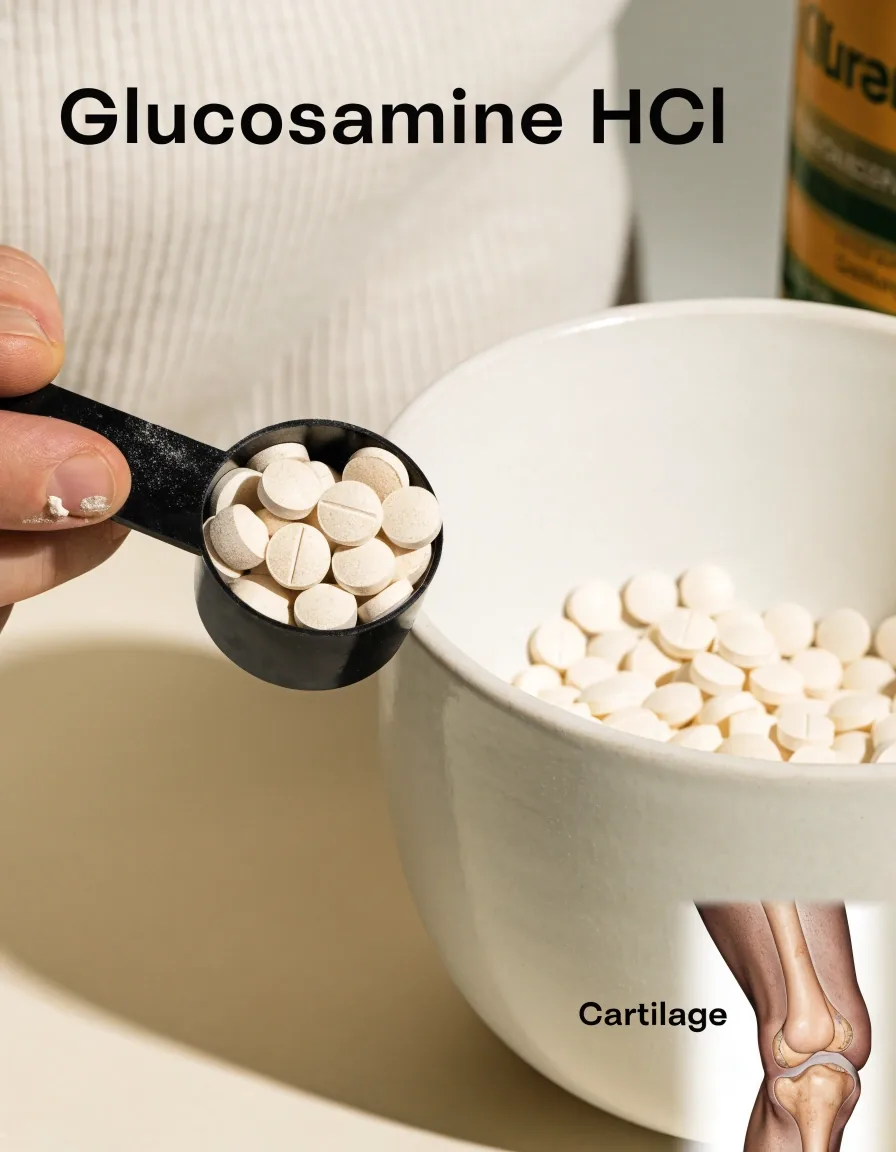
Glucosamine HCl turns up in most UK joint-support ranges, usually in tablets or capsules and often next to vitamin C, collagen, chondroitin or MSM. That pairing isn't random.
The label is showing you which part of a cartilage-support routine each ingredient is meant to serve. If you can read that pairing, you can compare two products in about a minute without opening either bottle.
Glucosamine HCl
Tablet or capsule
Pairs with vitamin C
Cartilage-support framing
Chondroitin
Capsule-led
Sits beside glucosamine
Traditional joint nutrient
MSM
Powder or capsule
Comfort and mobility
Rarely sold alone in the UK
Vitamin C
Capsule
Support nutrient
Appears across general formulas
Collagen
Peptides or type II
Connective tissue language
Two formats, different jobs
Our ingredient guide walks through each of these in the order you'll meet them on a shelf, starting with the ones you already half-know.
Read the ingredient guideThe one page where the paper flips
Collagen isn't one thing
Hydrolysed collagen peptides and undenatured type II collagen sit in the same aisle and do different jobs in a formula, which is why they're named differently on the pack. Hydrolysed peptides are broken down and appear in powders and capsules across general collagen ranges; type II is a branded, capsule-led option you'll usually find in specialist joint formulas rather than general multivitamins.
The difference matters when you're comparing two tubs at arm's length, because the format tells you what kind of product you're actually holding. The collagen formats page breaks the distinction down without the biochemistry lecture.
Hydrolysed peptides
Broken down during processing. Turns up in powders and everyday capsules, often alongside vitamin C.
Undenatured type II
Capsule-format ingredient with its own name on the pack. Usually found in specialist joint formulas.

Morning 07:00 · water, then movement
What a realistic daily routine looks like
Capsules only work as part of something repeatable. A short morning check-in, a glass of water, a walk to the shop: that's the shape most people settle into, and it's less about the capsule than about the habit wrapped around it.
The daily routine page covers timing, hydration and movement in plain terms, and it's honest about the fact that nobody judges a cartilage-support habit after a fortnight. Give it a season, not a weekend, and review how you feel over weeks rather than days.
Where botanicals fit
Boswellia and turmeric-based botanicals sit alongside the classic nutrients in several UK capsule formulas, and they're usually bundled with collagen and glucosamine rather than sold solo. If you've wondered why they keep appearing in multi-ingredient products, the answer is simpler than the marketing suggests.
They're positioned as part of comfort and mobility support, which is why they tend to appear on joint capsules rather than on a general multivitamin shelf. We explain how they're framed inside a formula in the ingredient guide, without turning the label into a promise about your knees.
Hyaluronic acid and the premium stack question
Hyaluronic acid is rarely sold on its own in the UK. It tends to appear in complex formulas alongside collagen, glucosamine or a mineral blend, which is why it often signals a higher-tier product.
That doesn't automatically make the stack better for you. It makes it more expensive, and the choosing-a-capsule page explains how to decide whether the extra ingredient earns its place in the bottle you're holding.
How to choose a capsuleReading a label before you trust the front
The front of the pack tells you what the brand wants you to feel. The back tells you what's actually inside, in what form, and at what position in the ingredient list. That order matters: ingredients are listed by weight, so a nutrient that appears low down the list is doing less of the work than the layout implies.
Read the ingredient names first. Then find the format of any collagen — hydrolysed peptides or type II carry different language on the pack. Then look at the serving instructions, because a formula that asks for four capsules a day is a different commitment from one that asks for one.
Anything on the front that doesn't have a corresponding line on the back is decoration. It's the most useful five minutes you'll spend in the supplements aisle, and it costs nothing.
Capsules versus powders
Powders are cheaper per serving and easier to adjust; capsules are easier to carry and easier to remember. There's no universal winner, though the UK market leans capsule-heavy for joint formulas because the ingredient stacks are easier to standardise that way.
Pick the format you'll actually keep using on a Tuesday in February. That's the only test that predicts whether you'll still be taking it in six weeks, and it's more useful than any comparison chart.
The shelf, read from the back first
Who this resource is for
If you're in Bristol, or anywhere in the UK, and you're trying to make sense of cartilage-support and mobility-support language without booking an appointment, this is written for you. We assume no science background and no loyalty to any brand. We do assume you'd rather understand a formula than be talked into one.
That means we write about joint capsules and natural joint care the way a careful friend would: naming what's in the bottle, what it's usually paired with, and what the label is asking you to believe.
Comparing glucosamine-led and collagen-led formulas
Glucosamine-led
Positioned around cartilage and mobility
Often paired with chondroitin, MSM or vitamin C
Collagen-led
Leans on connective tissue language
Hydrolysed peptides in powder, or type II in capsules
Both together
Common in multi-ingredient joint capsules
Sometimes on the same shelf, in the same shopping trip
The comparison on the collagen formats page shows how the two families differ in format and ingredient stack, so you can pick a starting point without overthinking it.
Long-term value over launch-week hype
A cartilage-support routine is a slow, boring kind of habit, and the products that hold up over time are usually the ones with readable labels and no dramatic promises attached. We'd rather point you at ingredient categories than at a countdown timer.
That's the standard this site tries to keep: less theatre, more rows on a label you can actually read.
What we don't do
We don't publish cure claims. We don't invent clinical proof, certifications or dramatic before-and-after stories, because none of that belongs in honest supplement writing. If you have a medical question about your knees or joints, ask a GP or pharmacist — that conversation is worth more than any page here.
Our job stops at the label. Tell us if something on this site reads as an overreach and we'll look at it again.
Find your starting topic
Skim the ingredient guide if you're brand new to joint capsules, or jump straight to the collagen formats page if you're already comparing two bottles. Either way, keep one question in mind: does this formula explain itself clearly? Everything else on this site is in service of that test.
Questions people ask before they buy
Which ingredients are most commonly used in cartilage-support capsules?
In the UK, glucosamine HCl, chondroitin, MSM, hydrolysed collagen peptides, type II collagen, vitamin C and hyaluronic acid are the ones you'll see most often. Botanicals such as boswellia appear in combination products.
How do collagen, glucosamine and chondroitin differ?
They're separate ingredient categories that often appear in the same formula. Collagen is a protein format; glucosamine and chondroitin are the traditional cartilage-support nutrients you'll see named on most UK joint ranges.
What is the difference between type II collagen and hydrolysed collagen peptides?
Hydrolysed peptides are broken down and used in powders and capsules across general collagen ranges. Type II collagen is usually a capsule-format ingredient in specialist joint formulas.
Are capsule formulas better than powders for daily use?
Neither is better on principle. Capsules are easier to carry and harder to forget; powders are cheaper per serving and easier to adjust. Choose the format you'll keep using.
What should someone look for on a joint-support label?
Ingredient names, their order in the list, and the format of any collagen. If the back of the pack is vague, treat the front as marketing.
How long do people usually stay on a joint-support routine before judging it?
There's no universal answer, and anyone quoting a fixed number of days is guessing. Most sensible guidance is to treat it as a seasonal habit and review how you feel over weeks, not days. Talk to a pharmacist if you're unsure whether a supplement fits with anything else you take.
Where to go next
Four chapters cover most of the questions people bring here. Read them in order if you're new, or jump to the one that matches the bottle currently on your kitchen table.
Ingredient Guide
Every category you meet on a joint capsule label
Read the ingredient guideCollagen Formats Explained
Peptides, type II, and which format fits your habit
Compare collagen formatsDaily Routine
Timing, water and movement in plain terms
Build a daily routineChoosing a Capsule
Deciding whether an extra ingredient earns its place
How to choose a capsule